Meet Our Partners





A pioneering 22-month collaborative on-farm field trial within sensitive catchments to depollute and regenerate the United Kingdom's once pristine and vital water-ways. This ambitious research project aims to bring together 3 separate catchments, soil types and councils to explore modern methods of regenerative agriculture with the intent of recovering landscapes and emplacing food, fuel and fibre supply chain security.
Forever Farm Ltd and its partners have been carefully selected by the InnovateUK ADOPT Programme to develop a farmer-led and commercially scalable turnkey solution to accelerate river regeneration and establish circularly innovative modern methods of agriculture.
This project has successfully secured £100,000 in match funding primarily from the InnovateUK ADOPT Programme. ADOPT — Accelerating Development of Practices and Technologies — is a DEFRA commissioned £139 million Farming Innovation Programme delivered by InnovateUK. It funds collaborative, farmer-led on-farm trials to generate and demonstrate practical solutions to agriculture's biggest productivity, sustainability and environmental challenges.
Our successful bid laid out the required team, resources and capital in order to deploy this ground-breaking research that will inform the adopted landscape recovery strategies and infrastructure of the future. In addition to engineering wetlands with 3D Buffer Systems, the project pushes the envelope of innovation by developing the open-source software in which Ecosystem Services and Natural Capital Assets can be platformed and exchanged — systematically transforming depleted and polluted river margins into vibrant and productive circular-economical assets that are verified for Returning Wealth to Earth and bolstering the bioeconomy.
Excess nitrogen and phosphorus from agricultural runoff is triggering eutrophication across English river catchments — depleting oxygen, breeding toxic algal blooms and degrading aquatic ecosystems. The Chew Valley Lake, River Leadon and River Frome all face documented, severe water quality failures.
Conventional grass buffer strips — the current regulatory response — become saturated over time, eventually releasing stored nutrients back into watercourses. Farmers face mounting pressure to act, but existing solutions ask them to sacrifice productive land without any financial return.
This project changes that equation entirely. By transforming passive buffer strips into three-dimensional, harvestable living biofilters, we create a model where protecting our rivers becomes the most commercially rational thing a farmer can do.
DEFRA identifies 3D buffering as a top-tier solution for landscape recovery. France has made equivalent systems mandatory. This trial establishes the UK evidence base needed for national adoption.
Diffuse N & P runoff from all three catchments causing eutrophication, regulatory penalties and barriers to development worth hundreds of millions in rural communities.
Industrial hemp + flax/linseed + deciduous trees planted in multi-layered buffer zones. Each harvest physically removes accumulated nutrients from the system — permanently.
The world's first compounded Phosphate + Nitrate + CO₂ credit — a verified, tradeable natural capital asset combining three ecosystem services into one bankable instrument.
Hemp bast for sustainable construction, flax-linseed for food-grade oils, biomass as renewable AD feedstock replacing environmentally damaging maize monocrops.
Multi-storey canopy creates habitat connectivity for pollinators and invertebrates with the hemp and flax incorporated as a rotational break-crop, serving as an off-season food source for birds and bees.
Hemp draws down 8–15 tonnes CO₂ per hectare per season (Shah, Cambridge; British Hemp Alliance). Only carbon locked into durable end-uses — hempcrete, bast fibre in construction — is creditable. The trial tracks the durable fraction through to end-use across all three sites.
Turning Environmental Stewardship into Essential Services
What is ESaaS?
ESaaS is a new farm business model that enables farmers to systematically identify, quantify, verify and monetise the ecological services their land already generates — and to design farming systems that deliberately maximise those services alongside food production. It is the commercial architecture that makes regenerative farming economically inevitable.
Farmers have traditionally provided ecosystem services. However, they have never been adequately rewarded or incentivised for them — until now.
Carbon stored in soil, nutrients captured in buffer zones, biodiversity habitats maintained at field margins, clean water filtering through wetland banks — these are economically valuable services that farms have delivered for generations. Without a framework to verify, register and trade them, they remain invisible to markets and unrewarded by policy.
ESaaS changes that. By embedding measurement, verification and monetisation directly into farm management, it creates a continuous revenue stream from the ecological work the land is already doing — and provides the commercial incentive to optimise and do more of it.
Both industry and governments have woken up to the fact that ecosystems are and should be treated as critical infrastructure. All sectors are environmentally indexed and depend on a stable and predictable ecosystem. Whether directly or indirectly through Environmental Social Governance (ESG), Corporate Social Responsibility (CSR) or Return of Wealth for Earth (ROWE) schemes, the sub-infrastructure to streamline and optimise the delivery of effective Ecosystem Services is achieved through the successful adoption of on-farm Ecosystems as a Service™ business models.
Nutrient capture and watercourse credits — paid by water companies and developers facing nutrient neutrality obligations
BNG units verified against DEFRA metric — mandatory for developers since 2024. Highest value per acre of any natural capital credit type
Soil carbon and biomass sequestration credits — growing corporate net-zero demand makes this the fastest-expanding voluntary market
The world's first compounded credit — three services, one asset. Unlocks premium pricing by packaging ecosystem service stacks into a single tradeable instrument
Climate Fintech — A New Era For Farming & Finance
The Natural Capital Bank™ is a verifiable digital registry with an immutable audit trail — open-source infrastructure that does for Ecosystem Services what the Stock Exchange did for equities. It creates the transparent, trusted foundation that allows natural capital to be treated as a credible, policy-aligned asset class, rooted in Return of Wealth for Earth (ROWE).
Built on independently verified on-farm data, the platform registers every measured Natural Capital Credit generated through the ESaaS framework as a discrete, tamper-evident entry in the registry. Each credit carries its full provenance record: which farm, which catchment, which methodology, which verification body — transparent and auditable from field to market.
This is not another offsetting scheme. It is the circular digital infrastructure that will serve as the backbone of the bioeconomy and the regenerative economy — one that rewards farmers for their environmental stewardship, provides governments and industry with credible, verified compliance assets, and creates a new form of community wealth in every bioregion where Modern Methods of Regenerative Agriculture is deployed.
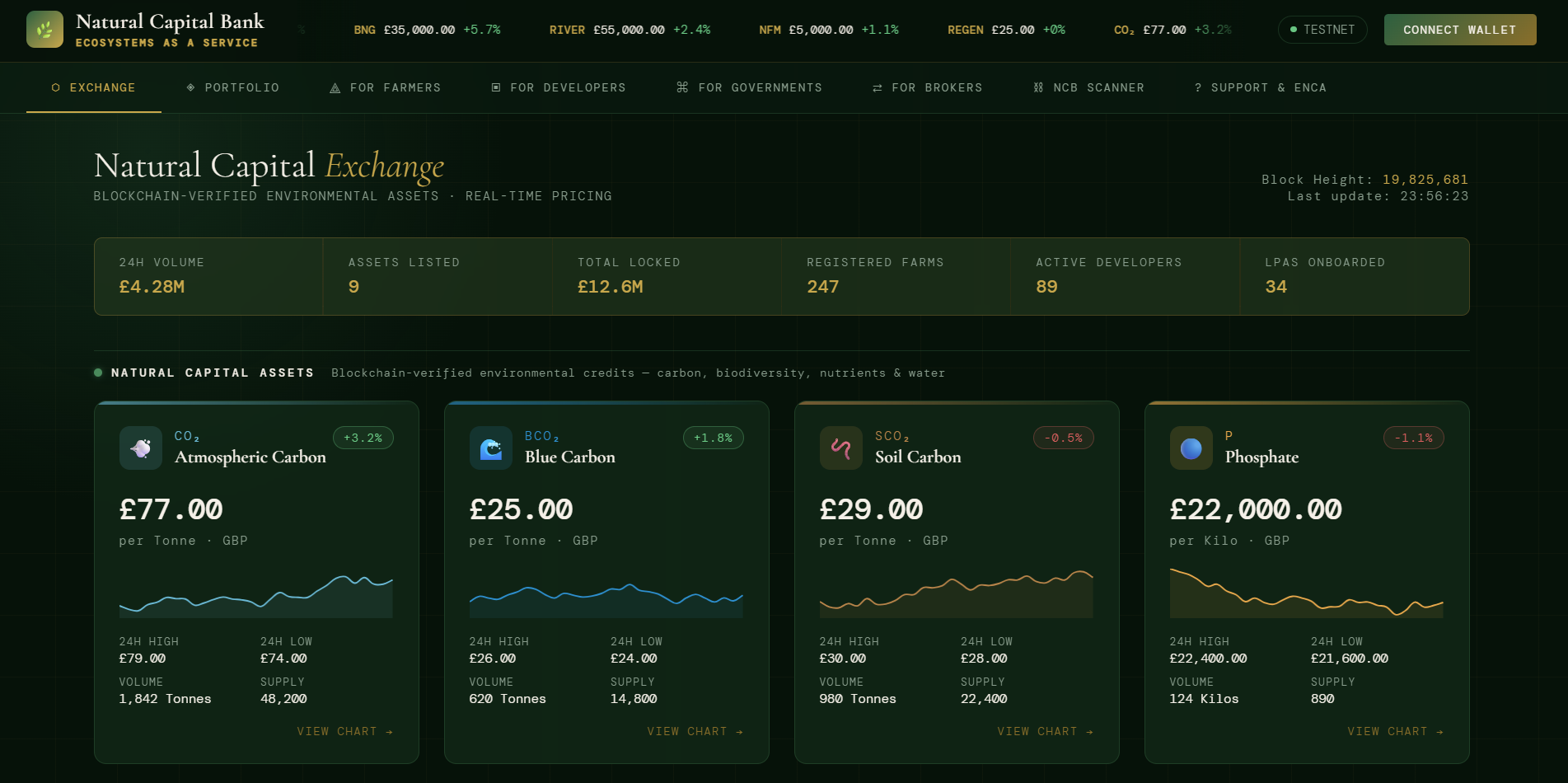
One of the most acute pressures facing English farmers is cash flow — the gap between ecological investment and financial return. A central question this trial sets out to answer is whether pre-verified forward agreements are feasible — that is, whether a credit can be contracted against ahead of harvest once its delivery is independently verified. If it can, ecological stewardship shifts from a cost centre to a bankable revenue line, with farmers earning from the point of verification rather than years later when a grant scheme pays out. Establishing whether this is workable, and on what terms, is a core output of the project.
Every credit registered as an immutable digital asset with full provenance record. No central authority can alter, cancel or inflate the supply — integrity is guaranteed by the protocol, not by trust in an institution.
All ecosystem service claims verified by accredited third parties against published methodologies before credit issuance. The PNCO₂ methodology developed in this trial becomes the first open-source standard on the platform.
Farmers, buyers and brokers connect on a transparent marketplace. Price discovery is real-time, transaction costs are minimal, and settlement is direct — no intermediaries extracting value from the ecological work of farming communities.
Each participating farm has a live dashboard showing ecological performance, credit inventory, market prices and cash flow projections. ESaaS becomes a core part of farm management, not a peripheral compliance activity.
The All-in-One Environmental Uplift Credit
Current natural capital markets treat phosphate capture, nitrate removal and carbon sequestration as separate, unconnected credits. This project creates the methodology and verification framework for the UK's first compounded PNCO₂ credit — a single, independently verified, tradeable asset that reflects the full ecological value of a 3D buffer system.
The PNCO₂ credit transforms buffer strips from regulatory compliance costs into bankable natural capital assets — creating a self-sustaining economic incentive for farmers to actively restore Britain's most vulnerable river catchments.
The PNCO₂ credit performs as a powerful economic vector — connecting the ecological surplus generated on farm to the regulatory obligations held by industry. It supports circular monetary policy by creating a closed-loop transaction where value that would otherwise be externalised (pollution, habitat loss, carbon) is instead captured, verified and exchanged. A developer required to achieve Biodiversity Net Gain under the Environment Act, a water company required to reduce phosphate loading under Ofwat AMP8, a corporation managing Scope 3 emissions under TCFD — all face statutory obligations with defined timelines and financial consequences. The PNCO₂ credit provides a single turnkey solution: one independently verified asset resolves multiple obligations simultaneously, at a fraction of the cost of end-of-pipe engineering alternatives. Industry gets compliance. Farmers get income. Rivers get clean. The Natural Capital Bank™ platforms the exchange and earns a transaction fee. Self-sustaining, replicable and policy-aligned.
Water companies · Developers seeking nutrient neutrality · Local authorities · Carbon markets · BNG compliance buyers · ESG corporate investors
Memoranda of Understanding (MOUs) are currently being developed with corporate buyers across the water, development and ESG sectors to secure advance off-take agreements — establishing guaranteed demand for Natural Capital Assets generated from the trial before credits reach the open market. These agreements are designed to give trial participants first-mover certainty, de-risk the commercialisation pathway and demonstrate to Landscape Recovery programmes nationwide that verified buyer demand exists at scale.
Ranges drawn from the published peer-reviewed literature, not house estimates. These are expected uptake into harvested biomass — the physical quantities the trial will measure on UK riparian soils, where no figures currently exist. They are not creditable volumes. See "How a buffer becomes a credit" below, and our Evidence Base & References for the peer-reviewed sources and the limits of each figure.
Biomass uptake is not directly convertible into credits. A nutrient credit prices phosphorus or nitrogen prevented from reaching the watercourse — not nutrient lifted out of the soil. The conversion between the two runs through five stages:
The core deliverable of this trial is the number at stage 2 — creditable export reduction per hectare of 3D buffer. It does not currently exist for the UK. Producing it, verifying it independently, and publishing the methodology open-source is precisely what this project is for — and what your sponsorship funds.
A single intervention can deliver several ecosystem services at once. Whether all of them can be credited — and on what terms — is the open policy question this trial addresses.
One 3D buffer simultaneously delivers phosphate interception, nitrogen removal, carbon uptake and biodiversity gain. Some combinations of these can already be stacked under current guidance; others cannot, and Defra and Natural England guidance is deliberately restrictive about selling the same ecological enhancement twice. ENCA (Enabling a Natural Capital Approach) provides the government's valuation guidance and databook — it is not itself a credit standard, and no compounded credit standard yet exists. The PNCO₂ methodology is being developed to establish precisely where the line falls — which services can be compounded from one plot without double-counting, and which must be excluded. That methodology, published open-source, is a primary output of this project.
Four independently growing markets. One compounded asset. Premium pricing for proven provenance.
Read these correctly. Nutrient credit prices below are per kg per year of permanent, in-perpetuity mitigation — a one-off payment to offset 1 kg/yr forever, secured by S106. They are not annual payments per kg harvested, and they cannot be multiplied by biomass uptake figures. Prices are catchment-specific and set by local supply and demand. Indicative published rates, for market context only.
Full Scale Trials to Full Scale Rollout
A successful trial does not stay in the Southwest. The modern farming and tech enabled methodology, verified regenerative protocols and replicable on-farm ESaaS models produced here are designed from the outset to be adopted across every nutrient-vulnerable catchment across the United Kingdom with exportable open-source potential.
Landscape Recovery is DEFRA's flagship large-scale environmental land management scheme — supporting landowners to enter 20-year agreements that fundamentally transform how land is managed across entire river catchments, floodplains, woodlands and wetlands. Currently covering approximately 240,000 hectares across England.
The System, The Platform and The Asset being developed through this ground-breaking research and development project, is purpose-built to integrate with Landscape Recovery delivery on a national scale — providing the quantified, verified evidence base that programmes need to demonstrate impact and unlock long-term public and private co-investment.
The trial produces open-access datasets, practical establishment guides and verified PNCO₂ methodology — everything a new catchment needs to deploy ESaaS without bespoke consultancy. The model is designed for zero-cost replication at scale.
Water companies are among the most motivated buyers of PNCO₂ and water quality credits — nutrient management upstream is dramatically cheaper than treatment downstream. The trial directly targets South West Water's Chew Valley catchment, creating immediate commercial proof-of-concept.
A national ESaaS network in which every buffer strip, riparian margin and ecological feature on every farm in England is generating verified, tradeable natural capital income — and the infrastructure to trade it exists in every catchment. This trial is the proof-of-concept that starts that chain reaction.
Economic modelling prepared for the ADOPT application indicates that on-farm ecosystem service and natural capital income has the potential to generate in the order of £3 of additional gross value added for every £1 invested, measured farm-wide over a ten-year horizon. This is a modelled estimate, not a guaranteed return — testing and refining it against real trial data is a core output of this project.
This project is co-funded by Forever Farm LTD and InnovateUK, covering 50% of the total research project costs. The remaining 50% match funding requirement, along with additional capacity to accelerate impact, expand outputs to other catchments and commercially roll-out ESaaS Farming Models and Natural Capital Bank™ing Solutions into the market, is what your sponsorship and collaboration directly unlocks.
The InnovateUK grant is secured — the grant offer letter has been received and signed. The project commenced on 1st June 2026 and runs for 22 months to March 2028 across three farms in Somerset, Gloucestershire and Herefordshire, capturing two full growing seasons. Season 1 crop establishment is already complete and in the ground. Sponsorship does not backfill the grant: it funds the expansion of the programme. Without it, the trial proceeds at significantly reduced scope — with the Natural Capital Exchange platform, extended monitoring and the national rollout pathway all curtailed.
With the project already commenced and the first crop established, the opportunity for sponsorship closes on Friday 1st January 2027 — the date the first laboratory batch from Season 1 is expected for delivery. Sponsors who commit before that point join the consortium ahead of the first verified results.
Sponsors underpin the research programme and its commercial development pathway both during and beyond the trial — establishing them as long-term industry partners in the ESaaS model, independent of the grant programme. Every sponsor receives named Founding Member Recognition on all published materials including peer-reviewed research studies, priority data access ahead of any commercial release, and direct access to institutional-grade innovation networks.
You don't need to leverage the professional merits of this project to be part of it. If you simply believe in the revival of Britain's rivers and want to see this work happen, a nominal donation of any size makes you part of the story.
Make a Donation →Four complementary organisations spanning practical farming, fibre-crop specialism, academic rigour and national knowledge exchange.
Seasoned organic grasslands and arable farmer with 40+ years' experience, biorenewable energy expert and former green-gas lead for Ecotricity. Advises government on sustainable agriculture policy. Leads species selection, 3D buffer system design and nutrient/carbon measurement at the River Leadon site.
3rd generation farmer with 20+ years in biodynamic and regenerative organic farming. Managing 100 acres under Natural England's Higher-Tier Countryside Stewardship. Provides the primary Chew Valley trial site — Bristol's drinking water supply catchment.
Experienced arable farmer specialising in industrial hemp and flax cultivation for bio-construction supply chains. Brings critical expertise in fibre crop agronomy, harvest timing and post-farmgate processing. Leads trials at Drythistle Farm across the River Frome catchment.
Industry professional specialising in circular economic development and ecological monitoring across Agritech and Bioconstruction sectors. Responsible for project coordination, technical oversight, data integration, Natural Capital Exchange platform development and InnovateUK reporting.
Leads farmer-led delivery, adoption planning and knowledge exchange for the consortium. Coordinates InnovateUK compliance and disseminates outputs through IfA's network of 7,500 subscribers, 6,300 farms and the Farm of the Future Programme reaching 3,000+ members across 28 countries.
Independent testing laboratory for the trial. All work is performed in a GAFTA-assured laboratory, with tests conducted to recognised ISO standards — covering soil nutrient analysis, plant tissue testing, water quality sampling and carbon content measurement. Live Lab holds no commercial interest in the Natural Capital Exchange platform, ensuring every figure underpinning a PNCO₂ credit claim is produced at arm's length from the parties who stand to benefit from it.
The £200,000 total programme runs from 1st June 2026 to 31st March 2028, structured across seven work packages in three sequential phases and capturing two full growing seasons. The trial establishes 30 acres of 3D riparian buffer — 10 acres at each of the three sites — with immediate expansion to 260+ acres across the participating farms on successful completion. Season 1 is already established and in the ground, and commercial sponsors are invited to support the research project as it develops.
Led by Marcus Morley-Jones. Project initiation, governance structure, InnovateUK reporting obligations, financial management and consortium coordination across all four partners. Monthly virtual steering group, quarterly in-person site reviews, live risk register. The management infrastructure that ensures every other work package delivers on time and to InnovateUK standards.
Led jointly by all three farmers. Home Office industrial hemp licences are held and in place for the trial sites — removing the single largest establishment risk before the project began. Site preparation, soil conditioning, seed and plant procurement, planting operations and early-stage crop management. Establishes four plot types per site — industrial hemp, flax/linseed, hemp-linseed companion crop, and control grass buffer — creating 12 trial plots across 30 acres of riparian buffer (10 acres per site) at Chew Valley (Somerset), River Leadon (Gloucestershire) and River Frome (Herefordshire).
Led by Arran Redman and all farmers with Innovation for Agriculture oversight. Systematic sampling at five physiological growth stages. Measurements include soil N & P levels, plant tissue nutrient concentrations, biomass yields, carbon content, biodiversity surveys, catchment water quality and full economic data. Standardised protocols across all three sites for cross-catchment statistical comparison.
Analysis conducted by independent laboratories including Live Lab, in a GAFTA-assured laboratory with tests to recognised ISO standards. Innovation for Agriculture and EcoversityUK jointly curate the panel of laboratories and academic reviewers engaged by the project. Soil nutrient analysis, plant tissue testing, water quality sampling and carbon content measurement. The laboratories and academics producing and reviewing the data are independent of the project and hold no commercial interest in the Natural Capital Exchange platform — every dataset underpinning a PNCO₂ credit claim is therefore produced at arm's length from the parties who benefit commercially from it.
Led by Marcus Morley-Jones. Full-stack development of the Natural Capital Exchange platform — a verifiable digital registry with an immutable audit trail, receiving, processing and publishing independently verified data from all three sites. Validates the ESaaS model in a live digital environment and establishes the first independently verifiable PNCO₂ compounded value. Covers platform architecture, registry and provenance infrastructure, data integration pipelines and credit issuance methodology.
Led by John Turvill. Post-harvest handling, processing and logistics of hemp fibre, flax-linseed and biomass crops. Coordination with bio-construction processors, AD operators and food-grade oil buyers to establish viable commercial offtake routes. Produces an economic model demonstrating the full revenue stack available to farmers deploying 3D buffer cropping across any catchment.
Led by Arran Redman with all partners. Six farm demonstration events across Somerset, Gloucestershire and Herefordshire. Video case studies, quarterly updates, final technical report, practical establishment guides and open-access datasets via InnovateUK ADOPT Support Hub. Disseminated through Innovation for Agriculture’s network of 7,500 UK subscribers, 6,300 farms and 28 European countries.
Ring-fenced at project outset and held centrally under WP1 governance, for reallocation on technical, regulatory or operational delays across any of the three phases. Covers unforeseen laboratory costs, harvest logistics complications, Natural Capital Exchange platform development overruns and any scope adjustments requiring steering group approval. Monthly budget tracking within WP1 enables early identification of pressure points before they affect delivery timelines or output quality.
The application was independently assessed across five criteria by three InnovateUK assessors and has been made a successful bid applicant of the Round 5 ADOPT Programme. Here are the headline scores and selected assessor commentary.
"The applicants are clearly aware of all the potential benefits from the perspective of improved water quality and productivity/resilience at the farm level... the team have the skills and experience to deliver the project."
"The ESaaS concept is commercially compelling and addresses a genuine catchment-scale challenge with a well-structured, farmer-led consortium across three contrasting sites. The risk register and dissemination infrastructure are strong."
"This application warrants funding as it is aiming to reduce a serious problem of water pollution in our river catchments and watercourses while at the same time offering farmers added revenue streams as opposed to sticking with the status quo of grassland belts."
Season 1 is already in the ground, and the first verified laboratory results are due on 1st January 2027 — the date sponsorship closes. Partners who join before then help shape a methodology that could transform how England manages its most vulnerable river catchments, and scale to 240,000 hectares; those who follow will be reading the findings rather than helping to write them. Your sponsorship doesn't fund a proposal. It supports live research as it develops, and unlocks the natural capital markets that make watershed restoration economically inevitable and ecologically meaningful.
All sponsorship is received by, and all sponsorship agreements are entered into with:
Forever Farm Ltd
Registered in England & Wales · Company No. 16984143
Registered office: Murrells End Farm, Murrells End, Redmarley, Gloucester, Gloucestershire, GL19 3LR, United Kingdom
Forever Farm Ltd is the lead partner and grant recipient for the trial. It is the sole counterparty for sponsorship. No other consortium partner, and no associated organisation, is party to your sponsorship agreement or liable under it.
The Forever Farm Foundation is the mission and stewardship body under which this work sits. Forever Farm Ltd is the incorporated company that conducts the Foundation's commercial affairs where a legal entity is required to do so — including holding the InnovateUK grant, contracting with sponsors, issuing invoices, and receiving sponsorship and donation payments.
In practice this means: you may encounter the Foundation's name and branding across this project, but every contract, invoice and payment relating to this trial is with Forever Farm Ltd, the entity identified above. Your legal counterparty is the company, not the Foundation.
Sponsorship is a commercial supply of benefits. In exchange for a sponsorship contribution, Forever Farm Ltd provides the schedule of benefits applicable to your chosen tier — acknowledgement, branding, data access, event invitations, briefings and, at higher tiers, advisory participation and commercial engagement rights.
Sponsorship benefits are delivered in kind. They are the entirety of what a sponsor receives.
For the avoidance of doubt, a sponsorship contribution:
Nothing in this prospectus or in these terms constitutes an offer or invitation to invest, or a financial promotion within the meaning of section 21 of the Financial Services and Markets Act 2000. Forever Farm Ltd is not authorised or regulated by the Financial Conduct Authority and does not provide financial, investment or tax advice.
| Tier | Contribution (excl. VAT) | Places |
|---|---|---|
| Bronze — Civic & Supporting Partner | £5,000 | 20 |
| Silver — Research & Development Partner | £10,000 | 10 |
| Gold — Corporate & Commercial Partner | £25,000 | 4 |
| Platinum — Strategic Partner | £50,000 | 2 |
The full benefit schedule for each tier is set out above and will be reproduced in your Sponsorship Agreement. The Sponsorship Agreement, once signed by both parties, is the definitive statement of what is owed to you.
Places are allocated on a first-committed basis. Forever Farm Ltd reserves the right to decline any sponsorship where it judges that the sponsor's participation would present a conflict of interest, a reputational risk to the trial, or a conflict with the terms of the InnovateUK grant.
Submitting the expression of interest form:
No sponsorship is binding on either party until a written Sponsorship Agreement has been signed by both.
Sponsorship contributions are payable on receipt of an invoice issued by Forever Farm Ltd, in accordance with the payment terms set out in the Sponsorship Agreement.
All sponsorship tier amounts are stated exclusive of VAT. Sponsorship is a taxable supply for VAT purposes, because the sponsor receives benefits in return.
Forever Farm Ltd is not registered for VAT at the date of these terms. Where Forever Farm Ltd is registered for VAT at the point an invoice is issued, VAT will be charged at the prevailing rate in addition to the tier amount and a valid VAT invoice provided. Where it is not, no VAT will be charged and the tier amount is the total payable. Sponsors will be notified in writing in advance of any change.
Sponsors should take their own tax advice on the treatment of the contribution in their own accounts.
Sponsors may optionally place a deposit to reserve a place in their chosen tier ahead of a signed Sponsorship Agreement. Any such deposit:
Refund requests should be sent to hello@foreverfarmfoundation.org and will be processed within 10 working days.
If the trial is cancelled in its entirety before commencement of the sponsored activity, Forever Farm Ltd will refund sponsorship contributions in full, less any benefits already delivered and any costs already irrevocably committed on the sponsor's behalf, in each case itemised in writing.
The InnovateUK ADOPT grant is secured and the grant offer letter signed. The trial will therefore proceed regardless of sponsorship. Sponsorship funds the expansion of the programme beyond the grant-funded core — including the Natural Capital Exchange platform, extended monitoring, and the national rollout pathway.
If total sponsorship raised is insufficient to fund the full expanded programme, Forever Farm Ltd will notify all sponsors in writing setting out the revised scope and which benefits are affected. Any sponsor whose material benefits can no longer be delivered may elect to receive a pro-rata refund of the affected portion of their contribution.
Forever Farm Ltd will use all reasonable endeavours to deliver the benefit schedule in full and to the timetable set out in the Sponsorship Agreement.
Certain benefits depend on matters outside Forever Farm Ltd's sole control — including the terms of the InnovateUK grant agreement, the editorial and authorship policies of academic publishers, the requirements of independent verification bodies, and applicable law and regulation. Where a benefit cannot lawfully or practicably be delivered, Forever Farm Ltd will agree a substitute benefit of equivalent value with the sponsor in writing.
Sponsors are acknowledged and credited. Sponsorship does not confer academic authorship. Authorship of any peer-reviewed output is determined solely by intellectual contribution, in accordance with the standards of the publishing journal and the guidance of the Committee on Publication Ethics (COPE). Sponsors receive prominent named acknowledgement in publications.
Sponsorship does not confer any right to influence, direct, delay, suppress or amend the findings of the trial. The scientific conclusions of the research are determined solely by the data.
Analytical testing is conducted by independent laboratories, including Live Lab, whose work is performed in a GAFTA-assured laboratory with tests conducted to recognised ISO standards. Innovation for Agriculture and EcoversityUK jointly curate the panel of laboratories and academic reviewers engaged by the project. The laboratories and academics who produce and review the data are independent of the project and hold no commercial interest in the Natural Capital Exchange platform.
All sponsors will be disclosed in published outputs, in line with standard research-funding disclosure practice.
Where a benefit schedule refers to priority access, first option to negotiate, or offtake of Natural Capital Assets, this is an option to enter into negotiations on commercial terms to be agreed at the relevant time. It is not a sale, an allocation, a price commitment, or a guarantee that any such asset will exist.
Whether harvest-based nutrient removal can be accredited as valid, permanent mitigation — and whether pre-verified forward agreements are feasible — are open questions that this trial is designed to answer. No sponsor should assume any particular outcome. Any figures for credit values, yields or nutrient uptake published by the project are estimates drawn from the InnovateUK ADOPT application and publicly available research, and are subject to verification through the trial.
Intellectual property generated by the trial is governed by the consortium agreement and the terms of the InnovateUK grant. Any IP rights offered as a sponsorship benefit are expressly subject to those terms, and will be granted only to the extent that they permit.
The methodologies, datasets and establishment guides produced by the trial are intended for open-source publication via the InnovateUK ADOPT Support Hub.
By entering a Sponsorship Agreement you grant Forever Farm Ltd a non-exclusive licence to use your name and logo for the purpose of acknowledging your sponsorship, in the manner set out in your benefit schedule, for the duration of the project and in any archived or published outputs thereafter. You may withdraw this licence for future use on written notice.
Donations made through the "Support the Mission" route are voluntary gifts. They confer no benefits, no acknowledgement rights and no return of any kind, and are not sponsorship. Donations are not refundable.
Personal data submitted through the expression of interest form is collected by Forever Farm Ltd as data controller, on the lawful basis of legitimate interests (responding to a commercial enquiry you have initiated), and is used solely to contact you about sponsorship of this project.
Your data will not be sold or shared with third parties for marketing purposes. You may request access to, correction of, or erasure of your data at any time. Full detail is set out in our Privacy Notice.
Forever Farm Ltd's total liability to any sponsor, in contract, tort or otherwise, is limited to the amount of the sponsorship contribution paid by that sponsor. Neither party is liable for indirect or consequential loss, or for loss of profit, revenue or anticipated savings. Nothing in these terms limits liability for death or personal injury caused by negligence, or for fraud or fraudulent misrepresentation.
These terms, and any Sponsorship Agreement entered into under them, are governed by the law of England and Wales, and are subject to the exclusive jurisdiction of the courts of England and Wales.
Questions about these terms, or about sponsorship generally, should be directed to hello@foreverfarmfoundation.org.
Supports: "Conventional grass buffer strips become saturated over time, eventually releasing stored nutrients back into watercourses."
The saturation question is not settled. Habibiandehkordi et al. (2019, J. Environ. Qual. 48, 314–321, DOI 10.2134/jeq2018.04.0129) found vegetated buffer strip soils had greater P sorption capacity and a lower degree of P saturation than adjacent field soils, and had not saturated even after 57 years.
We cite this deliberately, because it cuts against our own premise. The honest position is that buffer performance is highly site-specific — depending on hydrological flow path, soil type, and the balance of particulate versus dissolved P. That variability is precisely the argument for a multi-catchment, three-soil-type field trial with a control grass buffer at every site.
Supports: "Transforming passive buffer strips into three-dimensional, harvestable living biofilters."
Supports: the N and P uptake ranges shown on the PNCO₂ panel.
Supports: the CO₂ drawdown range shown on the PNCO₂ panel.
The widely-circulated "22 tonnes CO₂/ha" figure originates in advocacy submissions, not peer-reviewed work. The credible published range is 8–15 t CO₂/ha, and that is the range we use.
More important: biomass uptake is gross uptake, not sequestration. Carbon in hemp that is anaerobically digested or burned is re-released. Only carbon locked into long-lived products — hempcrete, bast fibre in construction — constitutes durable removal, and every credible carbon standard rejects gross-uptake claims. The trial measures gross uptake and tracks the durable fraction through to end-use. Only the durable fraction is creditable.
Supports: the market-context pricing panel and the credit framework.
No compounded ecosystem-service credit standard currently exists in the UK. Some combinations of credits can be stacked under existing guidance; others cannot, and Defra and Natural England guidance is deliberately restrictive about selling the same ecological enhancement twice.
The PNCO₂ methodology is being developed to establish where that line falls — which services can be compounded from one plot without double-counting, and which must be excluded. It is an output of this trial, not a precondition of it.
Three categories, and we distinguish between them everywhere:
Published evidence — drawn from the sources above, cited, and attributable.
Indicative ranges — figures from the published literature, presented as expectations to be tested on UK riparian soils. These are not results.
Open questions — quantities that do not currently exist in the UK literature, and which this trial is designed to produce. Chief among them: creditable nutrient export reduction per hectare of harvestable 3D riparian buffer. No published UK figure exists. Producing it, verifying it independently, and publishing the methodology open-source is what this project is for.
Corrections, challenges and additional references are welcomed — please write to hello@foreverfarmfoundation.org. This section will be updated as the trial generates verified data.
The data controller for all personal data collected through this prospectus is:
Forever Farm Ltd
Registered in England & Wales · Company No. 16984143
Registered office: Murrells End Farm, Murrells End, Redmarley, Gloucester, Gloucestershire, GL19 3LR, United Kingdom
Contact: hello@foreverfarmfoundation.org
Forever Farm Ltd conducts the commercial affairs of The Forever Farm Foundation where a legal entity is required. For anything arising from this prospectus, Forever Farm Ltd is the controller and the point of contact for all data protection matters.
We are not required to appoint a Data Protection Officer. Data protection enquiries are handled by the company directors at the address above.
When you submit an expression of interest, we collect only what you enter on the form: your organisation, sector, contact name, job title, email address, telephone number (optional), the sponsorship tier you selected, and any free-text detail you choose to provide about your interest.
When you place a deposit or make a donation, payment is processed by Stripe. We receive confirmation of the transaction and the name and email associated with it. We never see or store your card details — these are handled entirely by Stripe.
When you simply read this page, your IP address is necessarily visible to the services that deliver it (see section 5). We operate no analytics, no tracking, no advertising cookies and no profiling on this prospectus. We do not build a profile of you, and we do not know who you are unless you tell us.
| Purpose | Lawful basis |
|---|---|
| Responding to your sponsorship enquiry and discussing next steps | Legitimate interests — you approached us about a commercial arrangement, and replying is what you would reasonably expect |
| Negotiating and administering a Sponsorship Agreement | Performance of a contract, or steps taken at your request prior to entering one |
| Processing deposits, sponsorship payments and donations | Performance of a contract and legal obligation (accounting and tax records) |
| Project updates and newsletters to confirmed sponsors | Legitimate interests — delivering a benefit you contracted for. You may opt out at any time |
| Meeting our reporting obligations to InnovateUK | Legal obligation and legitimate interests |
Our legitimate interests balancing test, stated openly: we have assessed that our interest in responding to a commercial enquiry that you initiated does not override your rights and freedoms. The data is business-contact data, provided voluntarily, used only for the purpose you supplied it, and you can object at any time. We consider this the least intrusive way to do what you asked us to do.
We use the following third parties. Each acts as a processor on our instructions, or as an independent controller for the limited purposes described.
| Service | What it does | Data involved |
|---|---|---|
| Formspree (USA) | Delivers the expression of interest form to our inbox | Everything you enter on the form |
| Stripe | Processes deposits and donations | Payment and transaction data. Card details are handled by Stripe, never by us |
| Netlify | Hosts this prospectus | Server logs, including IP address |
| Google Fonts | Serves the typefaces used on this page | Your IP address, when the page loads |
| Image hosting | Serves photographs and logos | Your IP address, when the page loads |
International transfers. Some of these providers are based in, or transfer data to, the United States. Where personal data is transferred outside the UK, we rely on the UK International Data Transfer Addendum, the International Data Transfer Agreement, or an applicable adequacy decision, as appropriate to the provider. You may request details of the safeguards in place at any time.
Under UK data protection law you have the right to:
To exercise any of these rights, write to hello@foreverfarmfoundation.org. We will respond within one month. Exercising your rights is free of charge.
If you are unhappy with how we have handled your data, please tell us first — we would rather put it right. But you always have the right to complain directly to the UK supervisory authority:
Information Commissioner's Office (ICO)
Wycliffe House, Water Lane, Wilmslow, Cheshire, SK9 5AF
Helpline: 0303 123 1113 · ico.org.uk/make-a-complaint
This prospectus is served over HTTPS. Enquiry data is transmitted over encrypted connections and held in access-controlled systems. Payment data is handled exclusively by Stripe, a PCI-DSS compliant processor. No security measure is absolute, but we take the protection of your data seriously and will notify you and the ICO of any breach that meets the statutory threshold, within the required timeframes.
Any material change to this notice will be published here with an updated version number and effective date. Where a change materially affects how we use data you have already given us, we will tell you directly.
This is a sponsorship prospectus. It describes a research and development trial funded by the InnovateUK ADOPT Programme and invites organisations to sponsor the expansion of that trial in return for a defined schedule of benefits.
It is published for information only and is directed at organisations considering sponsorship. It is not a recommendation, and it is not advice of any kind.
Nothing in this prospectus constitutes, or is intended to constitute, an offer or invitation to invest, an inducement to engage in investment activity, or a financial promotion within the meaning of section 21 of the Financial Services and Markets Act 2000.
Sponsorship contributions are payments for a commercial supply of benefits. They are not investments. They confer no equity, no shareholding, no loan rights, no security, no financial return, and no entitlement to any credit, asset or instrument generated by the trial. The full position is set out at clause 3 of the Sponsorship Terms.
Forever Farm Ltd is not authorised or regulated by the Financial Conduct Authority. It does not provide financial, investment, legal, tax or accounting advice, and nothing in this prospectus should be relied upon as such. Prospective sponsors should take their own independent professional advice before committing.
This prospectus contains forward-looking statements about the intended conduct, outputs and commercial potential of the trial. These reflect our current expectations and are inherently uncertain.
They depend on factors including — but not limited to — agronomic performance, weather, harvest outcomes, laboratory results, the evolution of UK environmental policy and regulation, the willingness of regulators to accredit novel mitigation methods, and the behaviour of natural capital markets that are themselves nascent. Actual outcomes may differ materially, and may be less favourable than described. No forward-looking statement in this document should be read as a promise, a projection of returns, or a guarantee of any result.
All quantitative figures in this prospectus are estimates, drawn from the InnovateUK ADOPT application and from the published literature set out in our Evidence Base & References. They are not verified results of this trial.
Where we cite indicative market prices for nutrient, carbon or biodiversity credits, these are published third-party rates given for market context only. They are not offers, valuations, or predictions of the value of anything this trial may produce, and they cannot be multiplied by the agronomic uptake figures shown elsewhere in this prospectus — the relationship between the two is precisely what the trial is designed to establish.
Whether harvest-based nutrient removal can be accredited as valid, permanent mitigation is an open question. No sponsor should assume any particular outcome, and no commercial decision should be taken in reliance on any figure in this document.
This project is co-funded by the InnovateUK ADOPT Programme, part of Defra's Farming Innovation Programme. Acknowledgement of funding does not constitute endorsement. InnovateUK, Defra, and the organisations whose logos appear in this prospectus have not endorsed, approved or verified this sponsorship offer, and are not responsible for its content.
Consortium partners, laboratories and academic reviewers named in this prospectus are described in their project roles. They are not party to any sponsorship agreement and bear no liability under it.
This prospectus links to external websites. We are not responsible for the content, accuracy or availability of any third-party site, and a link does not imply endorsement.
The content of this prospectus is © 2026 Forever Farm Ltd, except where otherwise attributed. ESaaS™, Ecosystems as a Service™, PNCO₂, Natural Capital Bank™ and Natural Capital Exchange™ are trade marks used by Forever Farm Ltd. Third-party names, logos and trade marks are the property of their respective owners and are used with permission or for identification purposes only.
Cited scientific works remain the copyright of their authors and publishers; they are referenced, not reproduced.
We have taken reasonable care to ensure this prospectus is accurate at the date of publication. It will be updated as the trial progresses and as verified data becomes available. To the fullest extent permitted by law, no warranty or representation is given as to the accuracy, completeness or fitness for purpose of the information in it.
If you believe anything in this prospectus is inaccurate, please tell us at hello@foreverfarmfoundation.org. We will correct it.
To the fullest extent permitted by law, Forever Farm Ltd excludes liability for any loss arising from reliance on this prospectus. Nothing here limits or excludes liability for death or personal injury caused by negligence, for fraud or fraudulent misrepresentation, or for any other liability that cannot lawfully be limited.
This prospectus and this disclaimer are governed by the law of England and Wales and are subject to the exclusive jurisdiction of the courts of England and Wales.
Complete the form below to register your organisation's interest in sponsoring this project.